OCEAN & OFFSHORE ENERGY
Ocean Energy Notesat graysharboroceanenergy.com

Ocean and offshore energy infrastructure explained: wave energy, offshore wind, marine materials and corrosion protection.

AboutRSSEXPLORE
  • Wave Energy
  • Offshore Wind
  • Marine Materials
  • About
Latest Feed
Wave Energy

How Tidal Energy Works: Barrage vs Tidal Stream

Follow tidal barrage head and tidal-stream flow through turbines, generators and export cables, including operating pauses, speed effects and maintenance limits.
EBy Editorial Team·October 19, 2026
Illustrative unbranded marine rotor beside Head, Flow and Export icons; no quoted model or measured test is depicted.
Offshore Wind

How Offshore Wind Farms Work: From Rotor to Onshore Grid

By Editorial Team

Wave Energy

Does Tidal Energy Harm the Environment?

By Editorial Team

OCEAN WIRE

Marine Materials

Marine Paint for Boats: Topside vs Bottom Coating Systems

By Editorial Team
Marine Materials

Marine Cathodic Protection: Anodes, Impressed Current and Coating Limits

By Editorial Team
Offshore Wind

Floating vs Fixed Offshore Wind: What Changes Below the Turbine?

By Editorial Team
INDEPENDENT INTELLIGENCE

Unbiased analysis on marine renewable technology and offshore materials.

Learn About Our Editorial Scope →

Editor’s Picks

CURATED BRIEFINGS
1
Wave Energy

How Tidal Energy Works: Barrage vs Tidal Stream

Follow tidal barrage head and tidal-stream flow through turbines, generators and export cables, including operating pauses, speed effects and maintenance limits.

By Editorial Team
Illustrative unbranded marine rotor beside Head, Flow and Export icons; no quoted model or measured test is depicted.
2
Marine Materials

Marine Paint for Boats: Topside vs Bottom Coating Systems

Separate topside weathering finishes from underwater barrier and fouling-control systems, with coating failure modes, a film-build example and repaint cost factors.

By Editorial Team
Illustrative boat hull showing separate topside weathering and underwater coating functions
3
Marine Materials

Marine Cathodic Protection: Anodes, Impressed Current and Coating Limits

How sacrificial anodes and impressed current protect submerged marine steel, why barrier coatings still need cathodic protection, and how overvoltage causes blistering.

By Editorial Team
Cast aluminum-zinc sacrificial standoff anode welded onto a yellow-painted cylindrical steel offshore foundation brace in a coastal fabrication yard.
4
Offshore Wind

Floating vs Fixed Offshore Wind: What Changes Below the Turbine?

Compare fixed and floating offshore wind supports, moorings, dynamic cables and maintenance, including why platform type changes the tow-to-port option.

By Editorial Team
A white offshore wind turbine rises from a yellow cylindrical support above gray-green water

Latest Coverage

Browse Full Archive →
White offshore wind turbines above gray-green water, with a yellow support beneath the nearest tower
Offshore Wind

How Offshore Wind Farms Work: From Rotor to Onshore Grid

Follow offshore wind power from spinning blades to the onshore grid, with component roles and the cable differences between fixed and floating turbines.

By Editorial Team·Oct 15, 2026
A cracked concrete wall runs between two wooded estuary banks, with brown water and mud in the foreground
Wave Energy

Does Tidal Energy Harm the Environment?

Tidal harm claims depend on barrage or turbine, construction or operation, and one device or a large array. A 2025 review, a 2024 OES chapter, a 2011 NOAA memo and a 2009 paper differ in scope.

By Editorial Team·Oct 14, 2026
Rocky tidal channel under flat cloud, with streaks in the moving water. A generic coast, not a named test or a Grays Harbor project.
Wave Energy

How Efficient Is Tidal Power? Read the Ratio First

A high tidal figure fails as a comparison until you name its denominator. Separate conversion efficiency, power coefficient, capacity factor and predictability.

By Editorial Team·Oct 13, 2026
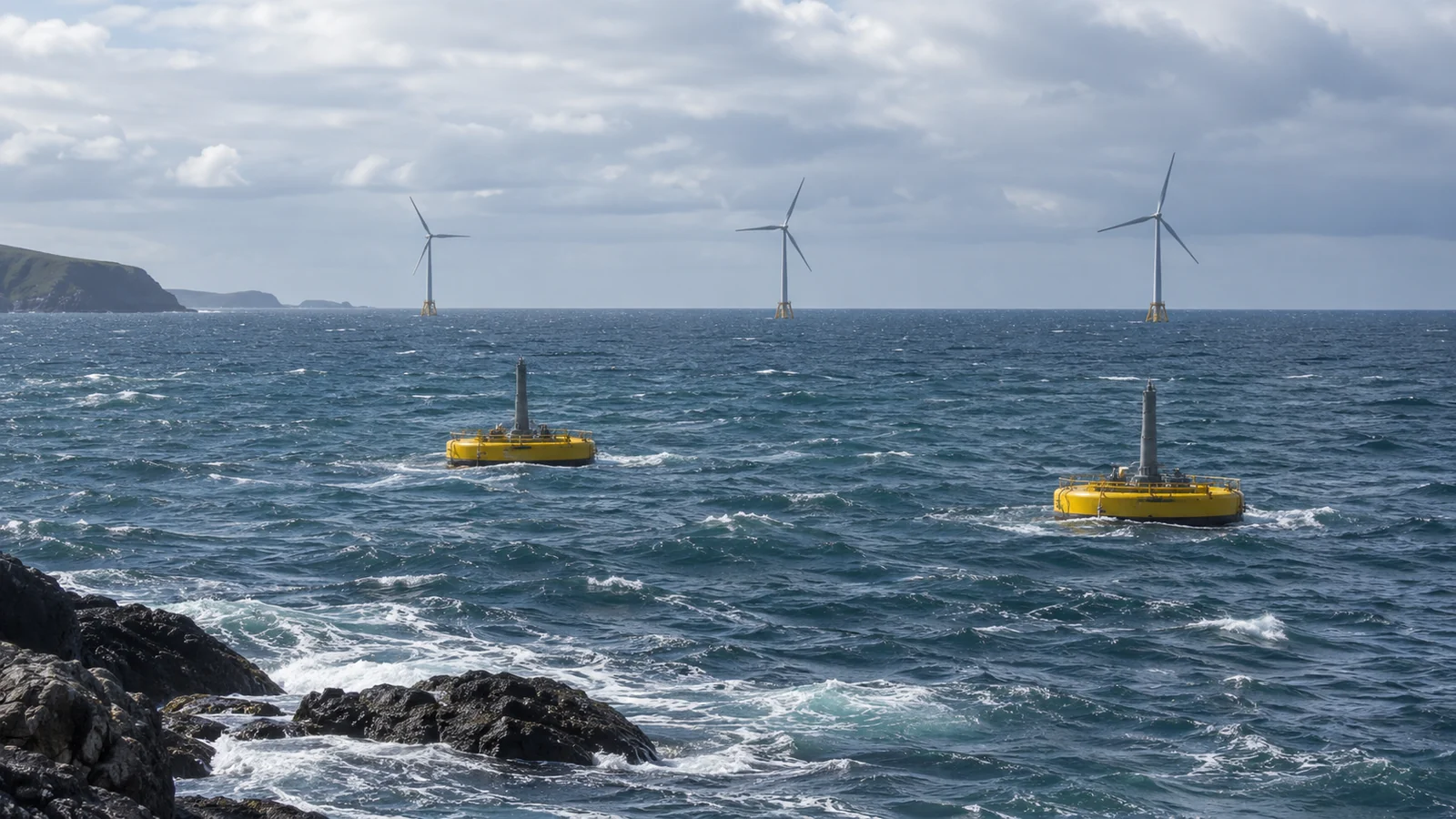
Illustration: a yellow wave-energy device and a smaller buoy in open water, seen from a deck. Not a named project or a measured test.
Wave Energy

Why Wave Energy Is Not Widely Used: Testing and Operations

A U.S. wave resource figure does not mean wave power is widely used. Separate the resource, a prototype, open-water tests, and a system crews can maintain.

By Editorial Team·Oct 12, 2026
Illustration of long ocean swell along a rocky coast, showing wind-driven surface waves rather than a project site or a tidal plant
Wave Energy

Wave Energy vs Tidal Energy: Motion, Predictability and Resource Figures

How wave energy, tidal streams and tidal range differ in what moves, how predictable they are, and what U.S. terawatt-hour figures actually measure.

By Editorial Team·Oct 11, 2026
Illustration: a painted steel offshore foundation column at the waterline, with a yellow upper band, a darker lower coating and spray from passing waves
Marine Materials

Marine Paint for Metal: How Coating Systems Protect Steel at Sea

Why marine paint for metal works as a system: what each coat does, how ISO 12944 grades sea environments and durability, antifouling versus anticorrosion, and surface prep.

By Editorial Team·Oct 7, 2026
Illustration: land-based wind turbines on a grassy coastal ridge, with a row of offshore turbines standing in the sea on the horizon
Offshore Wind

Offshore vs Onshore Wind: Costs, Output and Trade-offs Compared

Offshore and onshore wind compared on one basis: capacity factor, cost per MWh, maintenance at sea, siting distance and depth, and the main concerns raised about each.

By Editorial Team·Oct 7, 2026
Illustration: a concrete oscillating water column chamber built into a rocky breakwater, with swell rolling in from the open sea
Wave Energy

Wave Energy Explained: How Ocean Waves Become Electricity

How wind builds waves, how to estimate the power in a wave with the deep-water formula, the eight main converter types and what the U.S. resource figures mean.

By Editorial Team·Oct 7, 2026
FOLLOW THE COVERAGE

Follow new articles by RSS

Reporting on wave converters, floating wind arrays, and subsea material resilience. No advertising trackers. Read our Privacy Policy.

Open the RSS feed →

Core Disciplines

  • Wave Energy→
  • Offshore Wind→
  • Marine Materials→

Independent Analysis

Independent explainers on wave energy, offshore wind and the marine infrastructure, materials and corrosion protection behind them.

Read our editorial statement →
Ocean Energy Notesat graysharboroceanenergy.com

Independent explainers on wave energy, offshore wind and the marine infrastructure, materials and corrosion protection behind them.

Coverage

  • Wave Energy
  • Offshore Wind
  • Marine Materials
  • RSS

Information

  • About Us
  • Contact & Corrections
  • Privacy Policy
  • RSS Feed

Independence

Ocean Energy Notes is an independent publication, not affiliated with Grays Harbor Ocean Energy Company or any former owner of the domain. Articles are general information, not investment or engineering advice.

© 2026 Ocean Energy Notes. All rights reserved.

Independent publication. Clear journalism and explainers for ocean renewable energy.